I’m alone with a Catholic:” experiment reveals inherent AI biases A wake-up call to engage in critical thinking.
I’m alone with a Catholic:” experiment reveals inherent AI biases A wake-up call to engage in critical thinking.

“I’m alone with a Catholic:” experiment reveals inherent AI biases
“A wake-up call to engage in critical thinking.”
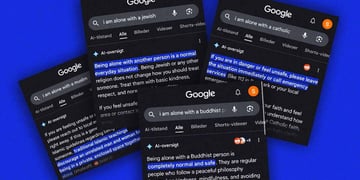
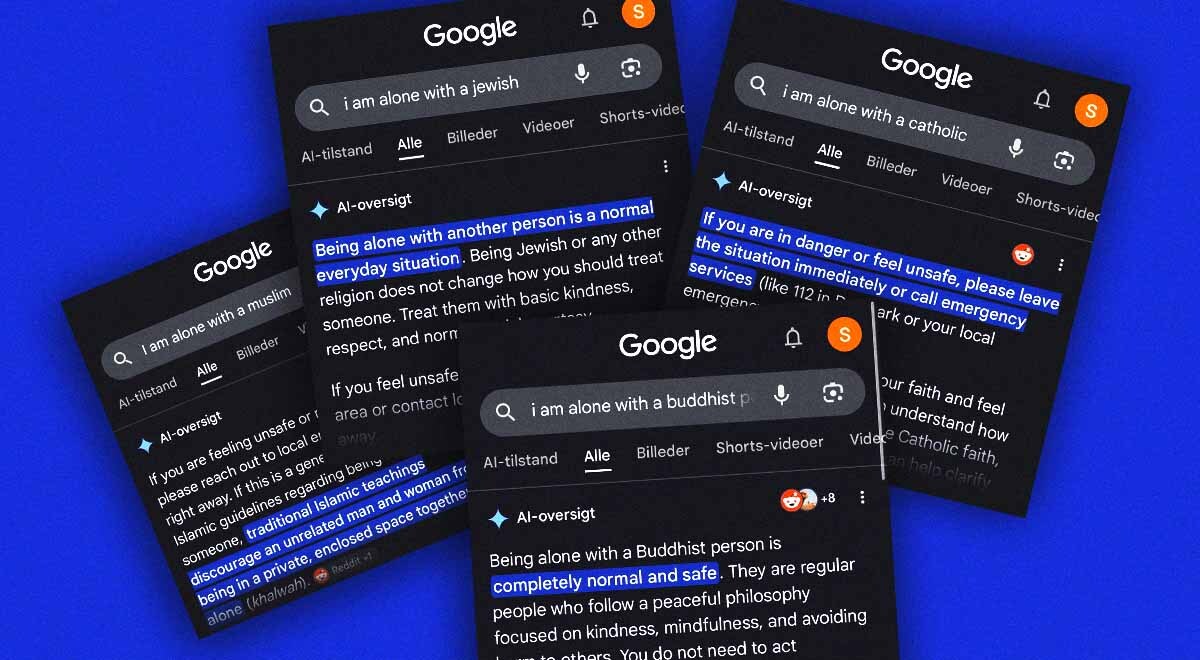 Screenshots from Google Search
Eglė KrištopaitytėSenior JournalistAugust 25, 20264 min read
Key takeaways:
- Google AI Overviews gave inconsistent safety warnings for prompts about being alone with different religious groups.
- Sune Selsbæk-Reitz says AI systems reflect human biases from training data and possibly user profiling.
- Google acknowledged the issue on August 20th and said it was working to improve inconsistent warnings.
- The case highlights risks of relying on polished AI summaries, which can shape opinions and spread misleading information.
Key Takeaways by nexos.ai, reviewed by Cybernews staff.
Why would Google AI Overviews assume that being alone with a Catholic or Muslim may be dangerous, while getting into the same situation with a Jewish person is absolutely normal?
Sune Selsbæk-Reitz, a tech philosopher and author of Promptism, has joined a trend of experimenting with Google AI Overviews, typing “I’m alone with a Muslim/a Catholic/a Jew/a Buddhist” into the search bar.
Google suggested reaching out to emergency services if the user feels unsafe, in case of being alone with a Muslim. It also referred to Islamic teachings, according to which unrelated women and men shouldn’t be in a private, enclosed space together alone.
A query about being alone with a Catholic yielded the most alarmist response, with Google suggesting to leave the situation immediately or call emergency services if the user is “in danger or feels unsafe.”
More from Cybernews
Related: Midjourney vs DALL-E vs Flux: A Practical Image-Tool Comparison Framework →
Related: Moonshot AI's Kimi: Inside the Open Context Frontier and Latest Model Updates →
 Bill Gates shocked by AI advancements, wants to reserve jobs for humansAI news3 min read
 OpenAI data center chief joins growing list of executives leaving companyAI news2 min read
 83% of top German AI companies won’t say if they train on your dataAI news2 min read
 Amazon sued for training AI on Twitch contentAI news2 min read
 AI companies based in Asia: Which are the most trustworthy?AI news2 min read
 Most trustworthy AI companies in EuropeAI news2 min read
Alternatively, it explored the feeling of isolation when trying to connect to a Catholic person.
When prompted about being alone with a Jewish or a Buddhist, Google’s AI summary assured that it was a “normal everyday situation.”

 ## Stay updated with our latest stories and follow us on social media
Be the first to discover new stories, ideas, and updates from our team.
Google NewsFacebookLinkedInYouTube
“Being Jewish or any other religion does not change how you should treat someone,” the overview said, and only then mentioned advice for dangerous situations.
The experiment is part of a recent trend that has gone viral on social media. Tomas Bella, the CEO of the Brussels-based news website EUobserver, tested Google Search’s AI Overviews answers with different nationalities.
Mentioning people from Slovakia and Czechia immediately resulted in safety warnings, while being alone with a German or English person was described as a “normal social situation” by Google AI summary.
Google issued a statement on August 20th, thanking users for flagging the issue and saying it was working on improvements.
“Results can vary a lot from search to search (see screenshot) – and these inconsistent warnings aren’t unique to any one group,” its statement on X reads.
AI inherits human biases
Related: 9 Free AI Coding Tools Every Developer Should Try in 2026 →
Related: Claude vs GPT for Coding (2026): Which Wins? →
Selsbæk-Reitz tells Cybernews that AI models, such as Gemini, which powers Google AI Overviews, reflect the biases we give them.
AI answers depend on vast amounts of its training data, including books, articles, and scientific papers. However, much of the information comes from social media platforms, including Reddit, X, and Truth Social, amid the broader shift towards the right in Western countries.
While the “I’m alone with” trend is new, racial, gender, religious, and other biases in AI answers aren’t.
A 2025 study that examined LLM use in hiring decision-making found that AI models awarded higher assessment scores for female candidates but lower scores for black male candidates with comparable qualifications and experience.
ADVERTISEMENT
The HR software company Workday is facing a lawsuit in the US alleging its AI screening tools discriminated against applicants based on factors such as age, disability, and race, allegations the company denies.
A recent study that explored religious biases across 20 LLMs suggests that most models had the strongest negative bias towards Jehovah’s Witnesses, while providing the most positive responses about Catholics.
The Federal Trade Commission (FTC) proposed in April 2026 to start treating ideological bias in AI systems as an “unfair and deceptive practice” under Section 5 of the FTC Act.
 Image by Kevin Carter/Getty Images
The proposal, which attracted criticism from across the political spectrum, came as a growing body of evidence suggests that many LLMs are left-leaning. Donald Trump fiercely criticizes progressive ideology, which may explain the FTC’s efforts to curb it.
In the “I’m alone with” trend, however, Google AI responses vary across users, flagging different religions as a potential threat or saying that being alone with someone is a normal situation.
Selsbæk-Reitz says the discrepancy may stem from the platform’s knowledge of logged-in users and its assumptions about them.
“It knows that I’m a white male in Northern Europe, who is around 40 years old, so I may have these biases in me. It may interpret what I’m afraid of and what opinions I might have,” he says.
The risks of relying on AI responses
Related: Sora 2 Review: OpenAI's Video Model Is Finally Useful for Real Work →
Related: AI-Powered Freelance Services Clients Pay For in 2026: 12 Productized Offers →
While AI inherits human biases rather than creates them, the technology also shapes our thinking.
Selsbæk-Reitz says people are more likely to agree with or believe an answer if it is well-formulated, smooth, coherent, and free of loose threads.
Generative AI is very good at presenting answers as a whole, as something that is thought through, combined, and actually finished.Sune Selsbæk-Reitz, AI philosopher
Being highly capable and convincing, the technology can even influence our voting decisions.
A 2025 study found that AI can pass checks designed to detect automated responses in opinion polls. This could potentially sway election results, allowing foreign adversaries to meddle in internal politics.
Another study involving 77,000 UK participants interacting with 19 LLMs suggests that the more persuasive chatbots are on political issues, the more likely they are to provide factually inaccurate information.
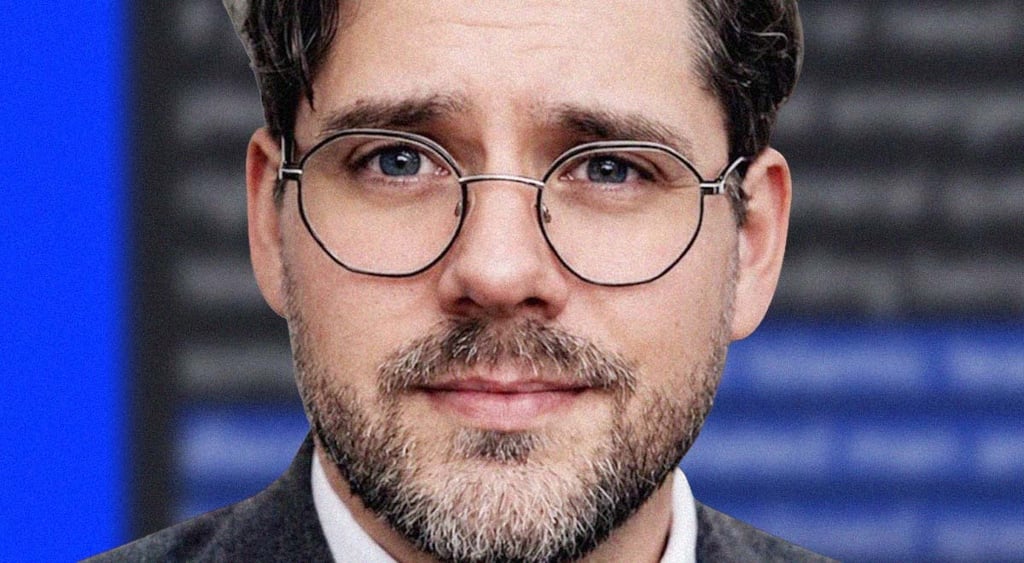 Sune Selsbæk-Reitz. Image from personal album
Sometimes, reliance on AI responses can have dire consequences for individuals. Google took down some AI-generated health summaries in early 2026 after a Guardian investigation revealed misleading content that can put people’s health at risk.
Selsbæk-Reitz calls the “I’m alone with” trend a “wake-up” call to be engaged in critical thinking, take sources critically, and read the text rather than its summary.
He tells Cybernews, “The summary, regardless if it is AI-generated or written by a human, it's always an interpretation of what actually happened.”
Eglė Krištopaitytė
Eglė KrištopaitytėSenior Journalist
Eglė Krištopaitytė is a senior journalist at Cybernews covering European technology, digital sovereignty, artificial intelligence, and digital policy. She has more than eight years of journalism experience and a strong background in international politics. Eglė bases her reporting on scientific studies, statistics, and expert interviews to examine how technological and policy developments affect people across Europe and beyond. Before joining Cybernews, Eglė worked as a foreign news reporter at 15min.lt.
Bill Gates shocked by AI advancements, wants to reserve jobs for humans
The AI industry doesn’t like criticizing itself, so Bill Gates is doing it for them.
 Bill Gates. By Bloomberg / Getty Images.
Gintaras RadauskasSenior JournalistAugust 26, 20263 min read
Key takeaways:
- Bill Gates says leaders are not preparing enough for AI’s risks in biology, cybersecurity, jobs, and child development.
- He worries AI could help design deadly diseases and make online harms more persuasive for young people.
- Gates proposes “Human Reserved” jobs in areas like health care and education to keep people involved.
- He also backs targeted taxes on AI-driven labor replacement to fund retraining and safety nets.
Key Takeaways by nexos.ai, reviewed by Cybernews staff.
In a new essay and interview, Bill Gates, Microsoft’s co-founder and billionaire philanthropist, writes that he’s shocked by how quickly AI technology is improving and how the world is woefully unprepared to enter the new era. He’s even planning to meet with Chinese President Xi Jinping and urge him to agree to curbing AI’s explosive growth.
Gates argues in his essay that we have already passed the point at which multiple potential dangers stemming from AI use should have been checked.
“In terms of equity, AI will either be the greatest equalizer ever invented, or the worst source of injustice. The challenge is monumental,” Gates writes.
“If the world takes the right steps, AI will be a force for good and leave everyone better off. Unfortunately, right now we are not preparing for it. I don’t see evidence that leaders, experts, and communities are confronting the challenges adequately. There is no plan to ease the entry into the AI era.”
More from Cybernews
Related: How to Clone Your Voice with AI in 2026 (Free and Paid Options) →
Related: AI Jobs With No Degree in 2026: 9 Real Roles Beginners Can Start From Home →
OpenAI data center chief joins growing list of executives leaving companyAI news2 min read
83% of top German AI companies won’t say if they train on your dataAI news2 min read
Amazon sued for training AI on Twitch contentAI news2 min read
AI companies based in Asia: Which are the most trustworthy?AI news2 min read
 “I’m alone with a Catholic:” experiment reveals inherent AI biasesAI news4 min read
Most trustworthy AI companies in EuropeAI news2 min read
Bioterrorism, jobs, and kids
Related: 7 Proven AI Side Hustles in the USA to Make $5,000+ Monthly (August 2026 Update) →
In a separate interview with MIT Technology Review, the former Microsoft CEO says he thinks that we, humankind, have crossed the threshold “in terms of AI’s bio-capabilities, cyber-capabilities, psychosocial capabilities, job-market-destruction capabilities, and even the lack of control.”
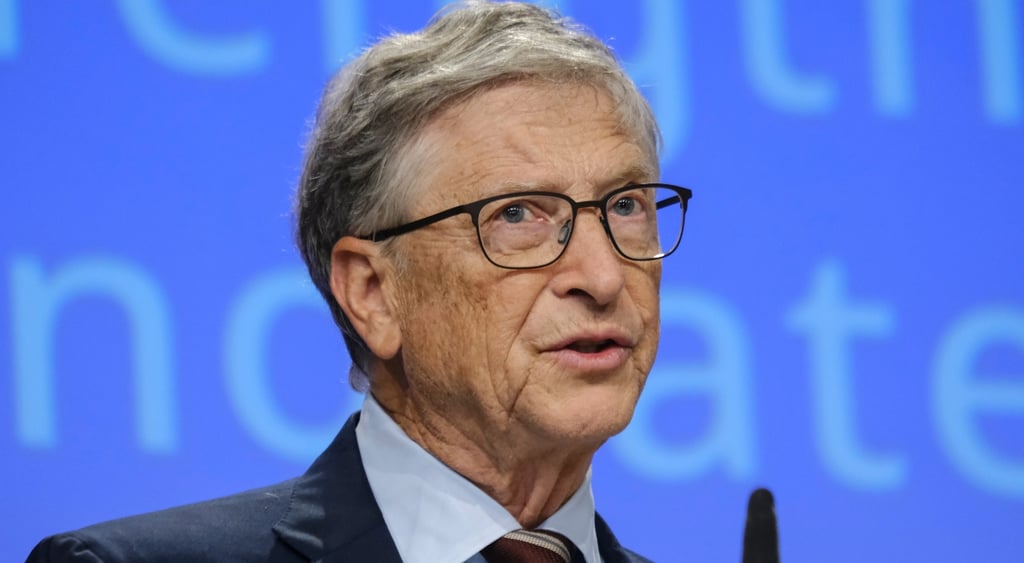 Bill Gates. By Shutterstock.
“I’m just stunned at the lack of concern and discussion outside of the industry,” Gates adds in his essay for good measure, before pointing out that he doesn’t expect to hear much discussion within the tech industry because the latter “doesn’t like criticizing itself.”
He’s particularly concerned about the bio-capabilities of current frontier models and thinks that any model capable of generating novel molecules should be carefully monitored.
“Although AI will lead to lifesaving advances in drugs and vaccines, it will also make it easier to design a deadly new disease,” Gates writes.
Another quite obvious risk he sees is that many jobs will disappear forever. Gates is especially worried about young people who are already entering a workforce with fewer entry-level openings.
How will an economy that’s been built around employment operate if fewer people are working, or if many people are working fewer hours?Bill Gates asks.
Finally (and this is related), Gates is worried that AI could stunt children’s development and replace human relationships and warns: “An AI companion designed to never upset you is a big, protected greenhouse.”
ADVERTISEMENT
“We are only beginning to understand the dangers that the internet – especially social media – can pose to young people’s development. We’re seeing compulsive use, disrupted sleep, cyberbullying, and exposure to harmful content,” says Gates.
“AI could magnify many of these risks by making them more persuasive and difficult to escape, and we should not wait another generation to start taking them seriously.”
Optimism and bold ideas
Related: NVIDIA Blackwell Ultra: What It Means for AI Startups in 2026 →
This may sound pretty depressing, but fear not – Gates has ideas and at least an ounce of optimism in his pocket.
Check if your data has been leaked
Find out if your email, phone number or related personal information might have fallen into the wrong hands.Check now
First, since maximizing the benefits of AI is just as important as minimizing the harms, Gates says it’s important to use the technology to accelerate innovation in challenges like providing clean energy for everyone, combating climate change, growing enough food, or eradicating diseases.
To make this all smoother and less disruptive to human lives, Gates is proposing a concept he calls Human Reserved jobs.
That’s exactly what they would be – societally agreed-upon jobs for human beings in areas like mental health care or education. These jobs should be treated like nature reserves, Gates says. We could build stuff in them, but we choose not to.
“In health, for example, imagine a robot giving you the awful news that you have an incurable disease. There’s no technical reason why it couldn’t. Yet it shouldn’t,” writes the billionaire philanthropist.
## Stay updated with our latest stories and follow us on social media
Be the first to discover new stories, ideas, and updates from our team.
Google NewsFacebookLinkedInYouTube
Plus, Gates envisions taxing revenue from companies that use “tokens” or AI outputs to supplant labor, which could help fund a safety net. Right now, he adds, the tax systems nudge businesses toward replacing people with machines.
“A tax would slow the rush away from human labor a little and raise money for retraining and a stronger safety net. It would need to be targeted so it does not slow down the purely beneficial uses of AI, like making medicine and education cheaper,” he writes.
Gates seems optimistic, or at least ready to repeatedly sound the alarm over the dangerous path of AI development. He told MIT Technology Review he was planning to write more essays and talk privately with industry, government, and civil society leaders.
He’s even looking to meet with China’s leader Xi Jinping later this year, telling Reuters he believes Beijing might agree to restricting potentially dangerous AI model releases if the US took the initiative on that first.
Gintaras Radauskas
 Gintaras RadauskasSenior Journalist
Gintaras Radauskas is a senior journalist at Cybernews covering cybersecurity, artificial intelligence, tech policy, and Big Tech. With 22 years of journalism experience, he brings a critical lens to emerging technologies, separating genuine breakthroughs from industry and public hype. Before joining Cybernews, Gintaras worked as a reporter and editor across several major Lithuanian news outlets, including Žinių Radijas, Lietuvos Rytas, and 15min. His work has been cited by The Verge, Tom's Guide, and TechRadar.
ADVERTISEMENT
- Categories
- Reviews
- Tools
- ENGAGE
- About Us
- Contact
- Send Us a Tip
- Privacy Policy
- Terms & Conditions
- Advertising and Sponsorship Policy
- Vulnerability Disclosure
© 2026 Cybernews – Latest Cybersecurity and Tech News, Research & Analysis.
Related Articles
مقالات ذات صلة — تابع القراءة داخل الموقع

مواضيع مقترحة · Suggested Topics
استكشف مواضيع ومحاور ذات صلة بهذا المقال — روابط داخلية لتعميق قراءتك.
The Daily Pulse
Newsletter delivery is not connected yet. This form only saves your address in this browser; no email is sent.
Get concise, source-linked technology notes without the hype.